

[p]Speaking to [i][b]Flashscore[/b][/i] after his panel at the [a href="https://portugalfootballsummit.com/" target="_blank"]Portugal Football Summit[/a], Moore reflected on Klopp's legacy, Arne Slot's difficult second season, the changing ownership picture at Anfield and his new adventure at Polish giants [a href="https://www.flashscore.ca/team/wisla/rob20Q2Q/"]Wisla Krakow[/a].[/p][p][b]At [a href="https://www.flashscore.ca/team/liverpool/lId4TMwf/"]Liverpool[/a] you oversaw an incredibly successful period. What made that team so special, and what made Jurgen Klopp the architect of that success?[/b][/p][p]"It was all me! Nothing to do with [a href="https://www.flashscore.ca/player/roberto-firmino/CCNtplZe/"](Roberto) Firmino[/a], [a href="https://www.flashscore.ca/player/salah-mohamed/08FBycgB/"](Mohamed) Salah[/a] and [a href="https://www.flashscore.ca/player/mane-sadio/xxskxOU0/"](Sadio) Mane[/a]. No, I was fortunate to be there at that time.[/p][p]For me, Jurgen got Liverpool. What do I mean by that? He got the fans. He understood the style of play the fans wanted to see. When he came in, he talked about Gegenpressing, heavy metal football. My first game was in 1959, and Liverpool fans throughout the decades have always had the same attitude. We win, we lose, typically we win more than we lose, but you had better try hard and you had better play entertaining football.[/p][image alt="Klopp won the Champions League with Liverpool back in 2019" id="ab6b45ca-1848-43fd-a264-e260176aba83" credit-line="Joe Giddens, PA Images / Alamy / Profimedia" guid="51823757-22f2-4c15-b746-64ba43143244" original-width="1400" original-height="931" /][p]"It goes back to the manager who changed it all for us, Bill Shankly, who talked about pass and move, pass and move. No matter who the players have been over the decades, Liverpool have always had this heavy metal approach. The phrase is Jurgen's, but whether it was Ian Rush, Kenny Dalglish, John Barnes, Robbie Fowler, Steven Gerrard, Luis Suarez or Fernando Torres, it has always been high- intensity, entertaining football.[/p][p]"Jurgen was the perfect manager and built a team that could play that way. It was an intense style, and the training needed to reach that level of intensity was demanding, but the fans loved it."[/p][p][b]Liverpool won the league, spent 400 million and then finished fifth. From your boardroom experience, what goes wrong somewhere in there?[/b][/p][p]"I'm just a fan now. I've never met Arne Slot, and with the exception of Alisson, Joe Gomez and Virgil (van Dijk), I've never met this team. I'm sitting 5,000 miles away as a fan, throwing things at the television depending on what's going on.[/p][p]"It was very difficult to fill Jurgen's shoes, but Arne did it. He played a style of football with the players he had that was reminiscent of that, and we won the league. The second year, what in America we call a sophomore slump, was more challenging. Unfortunately, at Liverpool, when the fans lose faith in the manager, it is very difficult for that manager to regain it.[/p][image alt="Arne Slot won the Premier League in his first season before being sacked" id="b4bf59e6-9b3c-47a8-a886-c18b16416089" credit-line="ČTK / AP / Jon Super" guid="438b1671-cf2a-4009-800e-ee0872795d4f" original-width="1400" original-height="933" /][p]"We embrace our managers more than our players. They are legends to us. If you watch on television, the banners on the Kop don't show our players. They show Shankly, (Bob) Paisley, Gerard Houllier, Rafa Benitez, (Kenny) Dalglish and Jurgen. Our managers mean more to us than our players. Unfortunately, it was a tough season."[/p][p][b]You worked with FSG. Now Amazon is coming in and taking a chunk of the club. Is this about commercial growth, an FSG exit, or somewhere in between?[/b][/p][p]"When an entity comes in at the valuation they apparently have for 38 per cent of the club, there has been a conversation about what ownership then looks like. You don't acquire that percentage for billions of dollars without having a path to full ownership.[/p][p]"The Amazon angle is a little silly, because Jeff Bezos has hundreds of multimillion-dollar investments. He has never said a word about Liverpool. I assume he knows he's an investor. It's really Amit Bhatia, and as you may have seen, he is married to the daughter of Mittal, which is where the real money is. To his credit, Amit has been at [a href="https://www.flashscore.ca/team/queens-park-rangers/OSWG7skE/"]Queens Park Rangers[/a] for 16 years. He's a football guy, he loves football.[/p][p]"A number of friends of mine have met with him over the last few weeks, and he's a real football guy. He is the person to keep a very close eye on as a future owner, and I always put that in inverted commas, of Liverpool Football Club."[/p][p][b]Multi-club ownership has become a phenomenon. BlueCo and City Football Group have done it, and FSG reportedly went as far as due diligence on [a href="https://www.flashscore.ca/team/getafe/dboeiWOt/"]Getafe[/a] and some French clubs before pulling out. Why do you think they pulled out, and is this model good or bad?[/b][/p][p]"The theory of multi-club ownership is the synergy of having clubs around the world. You can move players around, share players on loan, and give them experience in different leagues. You can have operational efficiencies and best practices, and move executives from one club to another to get international experience.[/p][p]"In theory, it's all great. I'm not totally sure whether it works in a way that justifies the expenditure, particularly at City Football Group, who have multiple clubs around the world, although I'm sure in their minds it works very well.[/p][p]"FSG lured Michael Edwards back as CEO of football on the theory that they were going to acquire a club. That's what he wanted to do, but it hasn't worked out, and that's why you're seeing Michael leaving and Richard Hughes, the sporting director, going to Saudi Arabia.[/p][image alt="Richard Hughes (L) and Michael Edwards (R) both left their roles" id="98b32017-66a8-4e09-91a1-1a455ae38bd7" credit-line="Kieran McManus / Shutterstock Editorial / Profimedia" guid="47545739-7a92-4c56-8d27-d6db8bf48b03" original-width="1400" original-height="882" /][p]"FSG are very, very savvy investors, and if they weren't seeing the upside of buying another football club and what the synergies with Liverpool would be, then they're going to say it's not worth their time."[/p][p][b]You know European and American football culture very well. What did you make of the World Cup, and how will it shape soccer culture in the US going forward?[/b][/p][p]I arrived in the US from the UK in the '70s and was coaching kids in Ohio. I always joke that it was looked at as a communist sport. It was very much an immigrant game, and where I was in Ohio, it was Eastern Europeans, Serbs and Yugoslavs. In the Midwest, there are cities with roots in European countries from the immigration of the past 200 years.[/p][p]"Later I became a football boot salesman for a company called Patrick, travelling up and down Southern California, and all the little independent soccer stores were owned by first-generation immigrants: English, French, Spanish, German, Italian, Dutch. They knew the game and could see the rise of youth soccer, but there was no professional league and nowhere for players to go. We lost them at high school to American football, basketball or baseball, because those had a professional path.[/p][p]"Then we got the 1994 World Cup. By then I was at Reebok in Boston and we were very involved. As part of it, the United States had to tell Sepp Blatter and FIFA that we would build a professional league, and that's how MLS was born. Now, from a viewership perspective and certainly in participation, the game is bigger than hockey and challenges baseball. It's embedded in American culture, maybe not at NFL or NBA level, but pretty darn close.[/p][p]"That five-year-old I was coaching in Ohio in the '70s is now 45, in some cases 55 with grandchildren. They played, their kids played, and they're a soccer family. You can thank NBC for the Premier League coverage, which is amazing in the US. You can thank Welcome to Wrexham and Ted Lasso for making the game feel like entertainment. And you can thank the streaming services, Paramount Plus, Peacock and ESPN Plus.[/p][p]"There is no league in the world I can't watch. I'm a part owner of Wisla Krakow and I watch all our games live on Ekstraklasa.tv in the United States. There aren't many professional games you can't watch live in the US, much more so than here in Europe."[/p][p][b]What brought you to Wisla Krakow? It's a traditional club that went down and has just been promoted back.[/b][/p][p]I got involved through video games. I was helping a game developer in Krakow, and one night in May last year he said: "I'd like you to meet Jaroslaw Krolewski." He's the 30-something owner of Wisla Krakow, an AI entrepreneur, a brilliant guy and a lifelong fan. As you point out, the club went down four years ago, and he has brought it back to the Ekstraklasa.[/p][p]"I spent the evening walking around the stadium pointing things out: this is what we would do at Liverpool; have you thought about this? The next thing, he said he wanted me to be an advisor, and I have some equity in the club. We love it.[/p][image alt="Wisla Krakow fans" id="3e56a619-d9c1-420d-9bdb-b4c38ca3f81f" credit-line="Hanc/Wired Photos / Shutterstock Editorial / Profimedia" guid="1b3eb603-afc2-4c4e-8993-f9da5fd1910e" original-width="1400" original-height="933" /][p]"We were there on Friday night and it was wild. We were winning 1-0, with no away fans in the stadium because they decided not to show up. They equalised, silence in the stadium, and then with the last free kick of the game we scored a header and the place went nuts. We won 2-1, the referee blew the final whistle and the place went crazy.[/p][p]"Eastern European football feels like the football of the '70s and '80s. There's a lot of pyro, a lot of tifos and a lot of fireworks that make me feel just a little uncomfortable, but it's raw. It's football in its most primitive sense, and I love it."[/p][p][b]The fan culture in Poland is probably second to none...[/b][/p][p]"Unbelievable. It's more controlled now, more family-oriented. The guys from 20 years ago may have been a little more rambunctious, but they're all older now. Jaroslaw says: "My ultras are doctors, lawyers, dentists... It's their day out."[/p][p]"The fan culture is amazing and there's no real trouble. Their kids go, and we create family environments in and around the stadium. It's super. It really is."[/p]

EXCLUSIVE: Former CEO Moore on Liverpool, the Amazon investment and joining a Polish club
Peter Moore was chief executive of Liverpool during one of the most successful spells in the club's modern history, a period that brought Champions League and Premier League titles under Jurgen Klopp.
Related stories
🎾 Tennis
New
Agassi calls for cuts to tennis calendar but says Laver Cup deserves place on it
Finley Crebolder at the O2 Arena
🎾 Tennis
New
Alcaraz & Zverev reluctant to take leading roles at the 2026 Laver Cup
Finley Crebolder at the O2 Arena
🎾 Tennis
New
'It is too much': Carlos Alcaraz wants end to late-night Grand Slam matches
AFP
🎾 Tennis
New
Team Europe's Zverev and Team World's Agassi defend 'spectacular' Laver Cup
AFP
🎾 Tennis
New
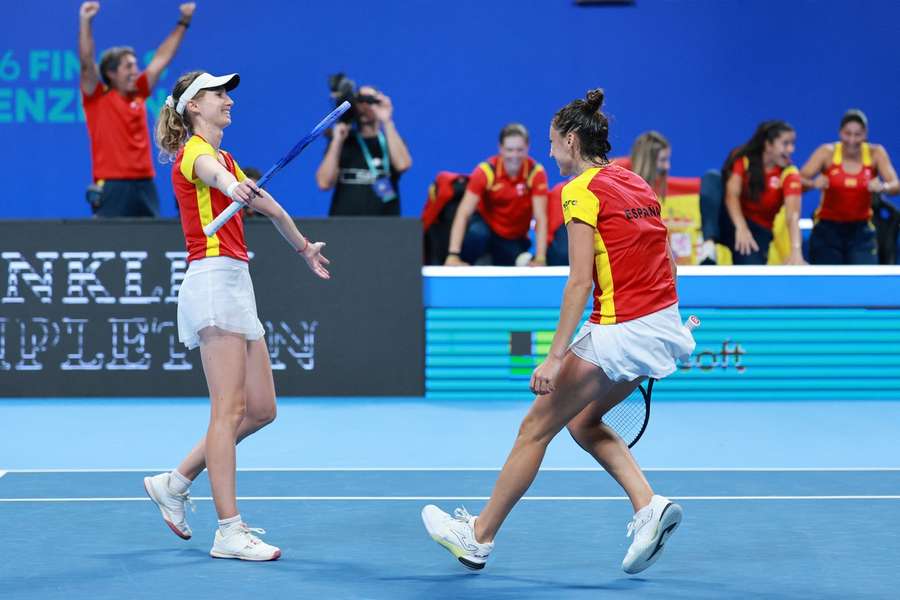
Spain survive scare to reach Billie Jean King Cup semi-finals for first time since 2008
AFP

🎾 Tennis
New
All you need to know about the 2026 Laver Cup: Teams, rules and dates
Ryan Murray