

[p]In the first part of an exclusive interview with [i][b]Flashscore[/b][/i], the former left-back looks back on Arsene Wenger's attention to detail, sharing a flank with [a href="https://www.flashscore.ca/player/ronaldinho/bLBp5a7c/"]Ronaldinho[/a] and the night at the Bernabeu when he realised Pep Guardiola's team was something special.[/p][p][b]Arsene Wenger brought you to Europe in 1999. When you arrived at [a href="https://www.flashscore.ca/team/arsenal/hA1Zm19f/"]Arsenal[/a], did you have any idea how that move would turn out?[/b][/p][p]"Well, no. It's very difficult to imagine everything. Looking back after some time, you can see how a footballer's life develops, but at the time everything is very uncertain. We had a contract for four years, then one more, so five years in total. In fact, I was the first Brazilian to sign for Arsenal. During my last three-and-a-half years with Albania, I coincided many times with Arsene Wenger, who works for FIFA. He was at many FIFA events and we had the opportunity to speak.[/p][p]"He always repeats a story. He tells me: '[a href="https://www.flashscore.ca/player/sylvinho/vmRZ1yMS/"]Sylvinho[/a], I went to Brazil to see another player, a left-back, and in the end you were playing against this team. I loved the way you played. I thought you were a little more defensive, a little more aggressive, but still very Brazilian, with good defensive qualities.'[/p][p]"And then, two months later, I signed for Arsenal. It was spectacular. I had a very good relationship with the president and his team. Arsenal is still a part of my house. It has changed, the owners have changed, the club has changed, but there is a very beautiful history behind it. I loved it. It was my first experience in Europe and it went very well. Arsene Wenger, David Dein and many more people at the club made a great impression on me. I still feel like I am part of that home."[/p][infobox id="0e8bad0a-7630-46a8-afe3-fa090b228a06" /][p][b]What did it mean to you to be the first Brazilian at Arsenal?[/b][/p][p]"Well, now it's easier to understand, but at the time we were 100% focused on playing football. It's normal. When you're 24 or 25 years old, you don't think about the fact that you are opening a door for other people. You just think about playing, doing things well and enjoying football.[/p][p]"But I've always been a person, even before being a player, who thinks about where I can go, what I can do and what I cannot do. I was absolutely convinced that I was opening doors for other footballers, not just for Sylvinho, the left-back who was doing his job there, but also on a personal level, in terms of life, education and respect. And then Edu Gaspar, Gilberto Silva and many others came later.[/p][p]"When I met Edu, he became a close friend. We always say, 'Good man, you did well.' I was with Edu for six months, almost a year. He didn't speak English, and I helped him with one thing, he helped me with another, and eventually we understood each other. We're a little older now, but I'm very happy with the memories we left behind."[/p][embed guid="59ee5ae9-4095-4a90-9421-95ed50fd0acb" url="https://x.com/Gunnersc0m/status/1939572107475902723" social-type="twitter" /][p][b]You speak very warmly about Wenger. Was he almost a footballing father to you, someone who shaped you as a person as well as a player?[/b][/p][p]"The word "father" in the world of football depends on the country. In football, depending on the country, you might say, "This is a father," or "No, be careful." Arsene was very intelligent, smart, very educated and a very good person.[/p][p]"He really helped me. Whenever I had to speak with him personally, he would say, 'Sylvio, sit down. How are you? How is your family?' I learned a lot from him. Right at the start, when my Spanish was better than my English, he would ask me: 'Sylvio, how are you? Do you already have the car? Do you know how to drive on the other side? Do you have a house? Has your wife arrived? Are you settled?'[/p][p]"There was no "father" here. There was a manager, a very intelligent manager, but he was also very attentive. At the same time, he would tell me: 'I'm going to correct you defensively. You are Brazilian, you play very well, you understand things very clearly, but you have to adjust.'[/p][p]"And I was learning. It wasn't easy. I had played in Brazil for three years and had two games for the Brazilian national team. I had won the Brazilian championship. Then I arrived at Arsenal and had to start adapting. It's hard for a young player because there is a process of adaptation. The Premier League has a very different rhythm, and defensively, if you fall asleep for even a moment, you can concede a goal.[/p][p]"I wanted to play, but I had left Brazil having played almost 300 matches for one of the best teams in the country. So, of course, when you arrive somewhere new, you have to wait for your opportunity. That was very smart from Wenger and from the whole club. He knew a lot about football. He knew where I had to enter, what I had to do and what he wanted from me at that moment.[/p][p]"Later, he told me we had won titles, but now we needed to defend better and I needed to get forward and play more on the outside. The wingers were being marked very tightly, so he knew what he wanted for the new season. He was a great coach and I learned a lot from him."[/p][p][b]You played with [a href="https://www.flashscore.ca/player/henry-thierry/S4aJ3ciG/"]Thierry Henry[/a], [a href="https://www.flashscore.ca/player/vieira-patrick/AaLVdEGK/"]Patrick Vieira[/a] and [a href="https://www.flashscore.ca/player/bergkamp-dennis/hbLChHP8/"]Dennis Bergkamp[/a]. What made that Arsenal team so difficult to play against?[/b][/p][p]"At that time, the two best teams in England were Arsenal and Manchester United. During the two years I was there, Manchester United and Arsenal were both very strong technically, physically and tactically. The structure of the two clubs was incredible. On one side you had Sir Alex Ferguson, and on the other Arsene Wenger. Imagine, I lived through all of that.[/p][p]"Arsenal was a team that was very good defensively. They were very strong physically and very brave. Then, in midfield, they were very structured and they had some of the best players in the world at that time.[/p][p]"It's incredible to think that I was at Arsenal with Henry, who was also going through an important moment in his career. There were moments when he would play and moments when he wouldn't, and then suddenly you realised: 'This player is Henry.' There wasn't much more to say. Then Dennis Bergkamp, what a player. What a footballer. Playing with Dennis was good, but training with him was even better. And there were so many others: Patrick Vieira, Marc Overmars, Emmanuel Petit and many more."[/p][embed guid="7f9ef77a-dbe9-4384-8688-aa5f7036c0e0" url="https://x.com/Gunnersc0m/status/1563044319128236032" social-type="twitter" /][p][b]Henry is now a big name on television. Did you see anything in him back then that suggested he would be a success there too?[/b][/p][p]"Well, we also coincided later at [a href="https://www.flashscore.ca/team/barcelona/SKbpVP5K/"]Barcelona[/a], so it was funny. We went through two important stages together. Henry, apart from being a great player, always showed that he was a very intelligent person. He's a guy who knows his stuff.[/p][p]"He knows how to connect with people. He knows how to hug people, how to talk to people. He has a way of communicating that people love. It doesn't surprise me that he's doing very well in football, not only as a former player but also now with his television programmes and the way he communicates and develops himself. He's a charming person."[/p][p][b]After Arsenal you joined [a href="https://www.flashscore.ca/team/celta-vigo/8pvUZFhf/"]Celta[/a], finished fourth and qualified for the Champions League. How do you remember your time in Vigo?[/b][/p][p]"It was the right place, the right moment. It was a very good period for Celta. We had four or five Brazilians, four or five Argentinians, two Russians, Karpin and Mostovoi, and others. It was a great team. We finished fourth, as you said, and the following year we played in the Champions League. We played against Ajax, Milan, and then in the round of 16 we faced Arsenal. It was a great experience. It was a pleasure.[/p][p]"Spain was something I had wanted to experience since I was 15, 16 or 17 years old. I really wanted to enjoy Spanish football because they played football very well. The older Brazilian players were very much in Italy: Socrates, Zico, Junior, Cerezo. Then the great Brazilian players of the 1990s, like Romario, went to Barcelona. When I saw Romário and his goals, I was a teenager. Then there were Rivaldo, Giovanni and many others. I wanted to be there.[/p][p]"It's true that it's a league where you enjoy playing football. It's not easy. People think it's just football, football, football, but you go onto a pitch and you can still get a blow. I spent eight years in Spain, three at Celta and five at Barcelona. It's a league that is fun and beautiful. It's less physical, although that is changing, but it's very technical. I really enjoyed that kind of football."[/p][image alt="Sylvinho celebrates with Messi and Eto'o." id="15d55a2b-c00c-4415-9aab-88941e319326" credit-line="ČTK / AP / David Ramos" guid="cc696a32-5d98-4c6b-b900-f0e1c16e000d" original-width="1400" original-height="938" /][p][b]In 2004 you arrived at Barcelona and a dressing room with Ronaldinho, [a href="https://www.flashscore.ca/player/xavi/bs5KnIiT/"]Xavi[/a], Eto'o, Deco and Puyol. What was it like on the inside?[/b][/p][p]"There were really two sides to it. On one side, there was the structure of the club: the president, the board, the coach [a href="https://www.flashscore.ca/player/rijkaard-frank/QcqRIjH8/"]Rijkaard[/a] and his staff, Txiki Begiristain and everyone involved in the sporting side. From the top down, the message was very clear: you are here because we want to achieve something important and win titles.[/p][p]"Titles, serious football, hard work and professionalism. That was the mentality. And then there was the family atmosphere inside the dressing room. There was a lot of respect and a very good relationship between everyone, but at the same time we were professionals. You came in, you worked and you left.[/p][p]"I think that's something I've learned after more than 15 years in football as a coach: many years can pass, but the same principles continue to apply. If you want to achieve something important as a team, everyone has to understand the same objective.[/p][p]"I spent five years at Barcelona, four of them with Rijkaard. The first two were especially successful. We won LaLiga and then the Champions League in Paris in 2005/06 against Arsenal. Ronaldinho had arrived a year before many of the others, but the mentality was the same. These players wanted to win titles, they visualised success and they built a team around that objective.[/p][p]"And of course, it wasn't only about having Ronaldinho, Xavi, Eto'o, Deco, Puyol or any of those names. There was an idea behind the team. The idea was simple: 'Guys, run. Work for 90 minutes in every game and in every training session.' That mentality made us a very strong team, especially during those first two years with Rijkaard. Looking back, I feel very lucky to have lived through that period and to have been part of that family."[/p][p][b]Was Ronaldinho as impressive in training as he was in games?[/b][/p][p]"The incredible thing was how easily he did everything. It was pure talent. I was very lucky in my career to play with people like that. I worked very hard and dedicated myself a lot, but I was also lucky to share a dressing room with some extraordinary players.[/p][p]"Ronaldinho did everything in training. You could play a little longer, try something, and he would do it naturally. But then he would take those things into games, and they worked. He did them as if he were still in training. He was a very different player. I was very lucky not only to play with him, but also to be close to him and play behind him. That gave me a lot of responsibility.[/p][p]"I remember one moment in particular. He asked me to give him the ball quicker because the full-back was 'eating his ankle', he was really putting pressure on him. With another player I might take two touches before giving him the ball, but with Ronaldinho you had to give it to him quickly. I remember us talking and laughing about it. I thought, 'I'm not even going to control the ball. He's coming towards me, so I'll give it to him straight away.' He would say, 'Hey, this guy is killing me. Give me the ball earlier!'[/p][p]"We were talking about a difference of maybe one and a half or two seconds. It might sound like a small thing, but those are the moments that make a difference with a player like Ronaldinho. If you give him the ball a second earlier, he can turn, unbalance the opponent and create something spectacular. Those are the beautiful little details you experience in football."[/p][image alt="Ronaldinho, Sylvinho and Xavi in training." id="4cfaf2a7-0c2e-407b-b841-917da89fd70f" credit-line="LLUIS GENE / AFP / AFP / Profimedia" guid="7b9e898e-8378-446a-ae64-26303c2ce481" original-width="1400" original-height="979" /][p][b]You lived through Pep Guardiola's first months as Barcelona's first-team coach. What surprised you about him?[/b][/p][p]"He was a player with a lot of experience, even though he was still very young as a coach. He had already done very well with Barcelona B. When he came to the first team, what impressed me most was the clarity of everything. I was one of the older players in the dressing room, so I was no longer 23, 24 or 26. When you are 35 or 36, you notice things differently. And everything was very clear.[/p][p]"It wasn't just Pep. It was the whole staff, the technical team, everything. There was control, but it was positive control, not military control. It wasn't, 'You're going to eat this or that.' It was, 'This is what we want, this is the training we want, and this is what we have to do.' We won almost every game. Barcelona was already a very good team, but it became even better. It was difficult to play against Barcelona before, but then it became a nightmare.[/p][p]"At that time, in 2008, there were big crises in the world and in Europe, and I remember seeing the Camp Nou with fewer people than usual. People were having a hard time. So playing good football and having the ball was spectacular, that's something we learned from Pep and his staff. But we also had to be willing to win the ball back quickly, recover it and bring energy to the game, and then pass that energy on to the people.[/p][p]"It's great when people are enjoying themselves because you play good football, but there is something else you can give them. The players wanted to win the ball back.[/p][p]"I remember one game when, as a full-back, I don't think I defended for five minutes. It was attack after attack: control, control, control, and then up again. Of course, we still had to defend, but it was different. That really surprised me. After that, Pep became one of the best, one of the very best. He is at the top of everything. I was around 37 or 38 when I really understood what he was doing, and it became very clear to me. And having things clear is important as a coach. I see that my players also need clarity, and that is something I try to give them."[/p][p][b]That treble-winning side is often called one of the best teams in history. When did you realise you were part of something truly special?[/b][/p][p]"For me, it was at the Bernabeu, when Messi started playing as a false nine. That was something we had worked on in training two or three days before the game. There were some specific details that involved two or three players who were going to play that day, rather than the whole squad. I'm speaking from what I saw, although I've also heard there were conversations with two or three players beforehand.[/p][p]"We went into one of the most difficult and iconic stadiums in the world, and it worked. When you see something like that work at the Bernabeu, you think, 'This is a formula that can work.' But there was nothing crazy about the idea. Quite the opposite. A lot of it came down to the person in charge, the way he was able to communicate the idea and put it onto the pitch. Pep was so sure about it.[/p][p]"And then, of course, you had great players who could make the difference. If you give me an eight and someone gives me a nine, 9.5 or 10, they can turn that eight into a 10. Everything came together that day. It was one of those games where everything worked perfectly."[/p][p][b]You played the full 90 minutes of the 2009 Champions League final against Manchester United in Rome. What went through your mind when Guardiola told you that you would start?[/b][/p][p]"We had some absences at the time because of suspensions and injuries. The Champions League final was on a Wednesday, and we had already won the Cup and the League. We still had two league games before the final, Mallorca and then Athletic Bilbao at Camp Nou on Saturday. About 10 days before the final, Guardiola came to me and said, 'Sylvio, come on, get ready. You're going to play the final. We have a few people missing, so you're going to play.'[/p][p]"I said, 'Perfect. Good.' Then he asked me about the Mallorca game: 'Sylvio, how do you feel? Do you want to play 45 minutes or something?' I said, 'No. I'm 35. I'm training, I'm feeling good and I know myself well. The more I play, the better I feel.' So I played 90 minutes in Mallorca, we came back, and then we had the game at home.[/p][p]"During the week I said to him, 'Mister, let me play more.' He said, 'No. 90 minutes, no. Don't think about it. Don't get yourself injured.' I understood him as a coach. He wanted to protect a more experienced player who was going to play in the Champions League final. He didn't want me to pick up an injury. But inside, I was very clear: I wanted to play. I wanted to enjoy those minutes.[/p][p]"We talked about it again on Saturday morning, before the game at Camp Nou. He came to the office and I said, 'Not today, Mister. Give me more.' In the end, we agreed on 45 minutes. He was a little angry. He said, 'Hey, if you're going to get injured, I'm going to...' But in the end, everything went well.[/p][p]"I knew how much I needed to play. I always felt very good physically and technically, and I loved the duels. I don't think I ever really defined myself properly as a player, but I'll try to explain it in a way that players around the world can understand: I loved going into duels.[/p][p]"I couldn't always get there first, but I had to get there early and enjoy the duel. If I didn't win the ball with the first action, I would try to steal it with the second. I loved that spirit, and my legs were responding to me. I played the full 90 minutes in Rome. I arrived in good condition because the team was very well prepared, and we knew the opponent was very strong as well. In the Champions League, anything can happen, but I felt ready.[/p][p]"I had already played 500 or 600 games in my career, so I had the experience. I was 35, but I was ready to play that final."[/p][infobox id="57fab436-18cc-4c5d-86f7-48a098a6ae42" /]
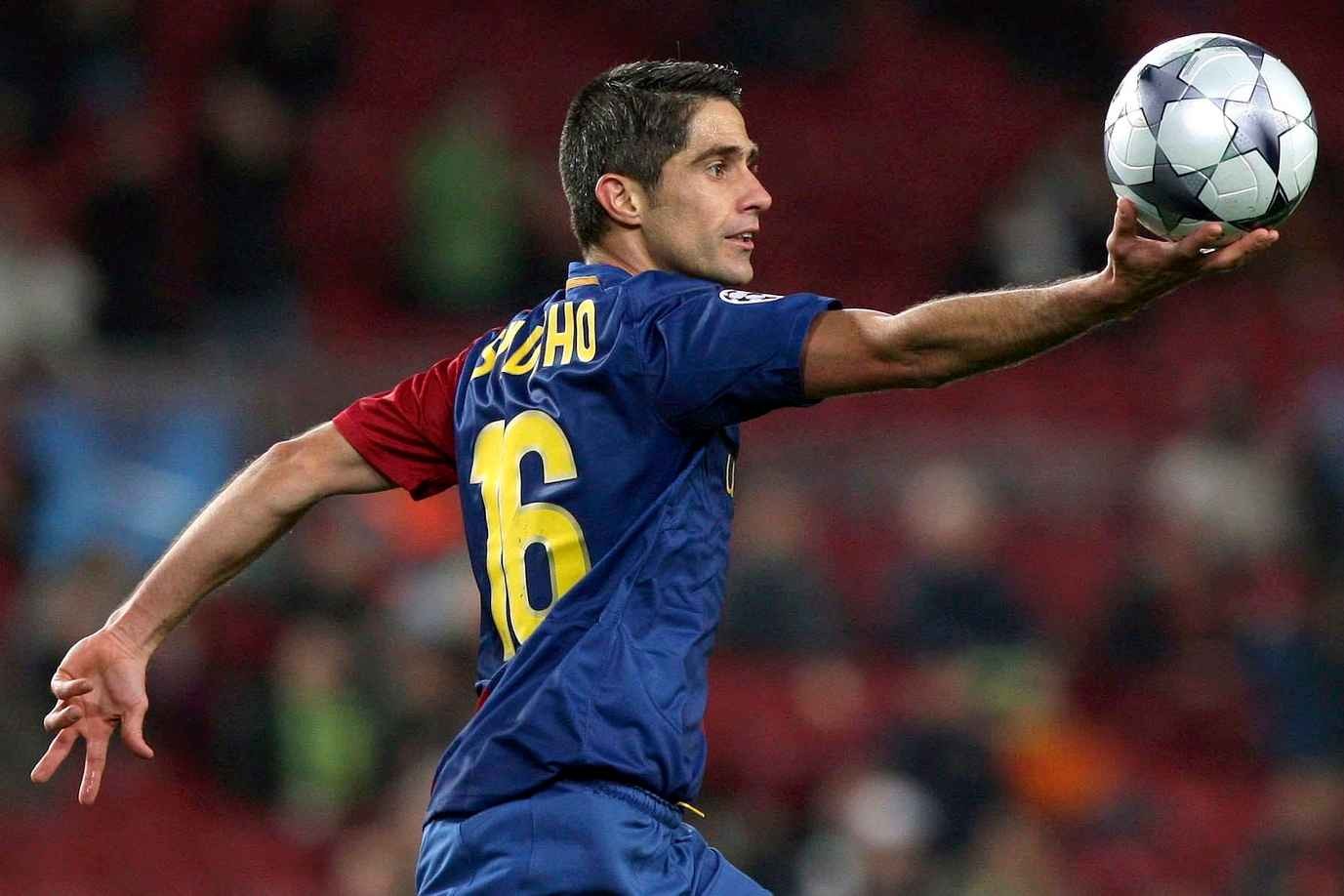
EXCLUSIVE: Sylvinho on Wenger's Arsenal, Ronaldinho and Guardiola's Barcelona
Sylvinho was the first Brazilian to sign for Arsenal, a Champions League qualifier with Celta Vigo and a two-time European champion with Barcelona, where he started the 2009 final against Manchester United at the age of 35.
Related stories
⚽ Football
New
'He is the best': Bellingham heaps praise on Kane after record-equalling appearance
Reuters
⚽ Football
New
Kane admits catching Ronaldo's international goalscoring record isn't unrealistic
AFP
⚽ Football
New
Lionel Messi describes final Argentina appearance as 'saddest day of my career'
AFP
⚽ Football
New
England coach Tuchel praises side for reaction after World Cup disappointment
AFP
⚽ Football
New
Rock solid Mbokazi shows his worth again as Dithejane contributes too
Nick Said
⚽ Football
New
Messi gets one last goal & emotional farewell in final match for Argentina
Jason Pettigrove